Google Unveils Genie 4, a Real‑Time 3D World Model
Google previewed Genie 4, a world model that generates realistic 3‑D environments and native audio for real‑time simulation. The model builds on Gemini and promises new possibilities for AGI research and creative industries.
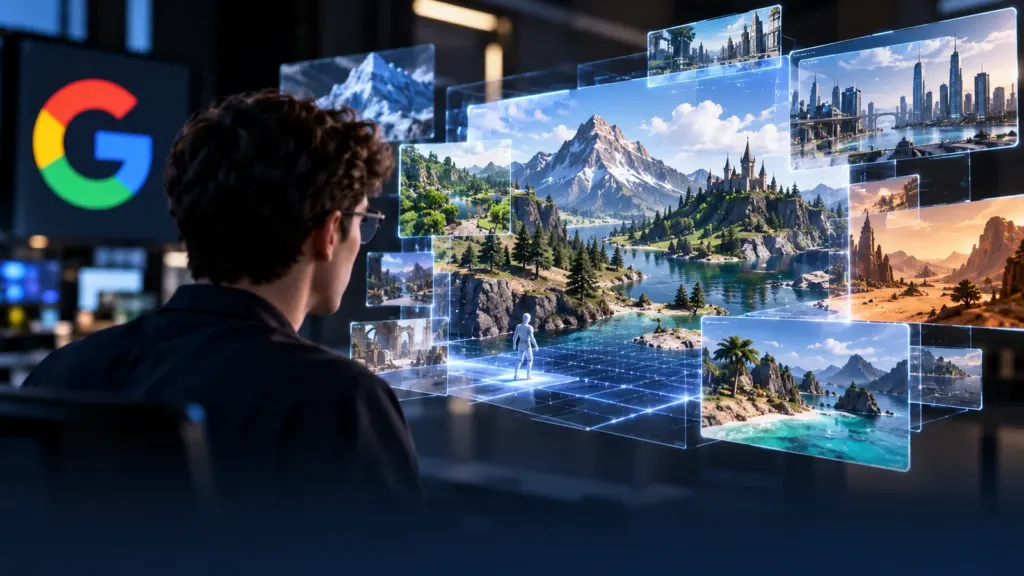
Google previewed Genie 4, a world model that generates realistic three‑dimensional environments and native audio for real‑time interactive simulation. The model builds on the Gemini family, using Gemini Omni to anchor simulations in real‑world appearance and behavior while other Gemini models provide the reasoning needed to maintain coherence and continuity. By allowing users to set an event in motion and steer scenes in real time with natural language commands—such as moving the camera, changing the weather, or introducing new characters—Genie 4 promises a level of immediacy that previous world models lacked.
Genie 4’s rendering engine improves fluid movements and complex details compared with its 2024 predecessor. The algorithm can generate accompanying audio on the fly, including ambient sounds, music, and interactive dialogue, a feature that sets it apart from earlier static or pre‑recorded audio approaches. This integration of visual and auditory realism positions Genie 4 as a comprehensive tool for simulation, enabling researchers to create safe training environments for robots and agents while also offering creative professionals a new medium for storytelling and design.
The announcement underscores Google’s broader strategy of advancing artificial general intelligence through large, multimodal world models. By combining realistic 3‑D rendering with native audio and natural‑language control, Genie 4 addresses two key bottlenecks in AGI research: the need for high‑fidelity sensory input and the ability to manipulate that input in a controllable, repeatable manner. The model’s capabilities also align with industry demands in filmmaking, journalism, gaming, and manufacturing, where immersive simulations can accelerate prototyping, reduce costs, and open new creative possibilities.
Real‑Time Simulation and Native Audio
One of Genie 4’s most compelling features is its real‑time interactive simulation. Users can issue natural‑language commands to alter the environment on the fly, and the model responds with updated visuals and audio that maintain internal consistency. This level of interactivity is critical for training autonomous agents, as it allows for dynamic scenario generation without the need for manual scripting or pre‑recorded assets. The native audio generation, which produces ambient sounds, music, and dialogue in sync with visual changes, eliminates the latency and mismatch issues that have plagued prior systems relying on external sound libraries.
From a technical standpoint, Genie 4 leverages Gemini’s reasoning capabilities to keep the simulation coherent. While Gemini Omni ensures that the world looks and behaves like the real world, other Gemini models interpret user commands, resolve ambiguities, and maintain narrative continuity. This architecture reduces the cognitive load on developers, who no longer need to manually script interactions or troubleshoot inconsistencies. The result is a more robust platform that can support complex, multi‑agent simulations with minimal human intervention.
Compute, Security, and Market Implications
Genie 4’s advanced rendering and audio synthesis demand significant compute resources. The model requires high‑density GPU clusters to process the real‑time updates and maintain fidelity, a requirement that echoes the challenges highlighted in the recent Senate bill discussion on AI data center power costs. As Senate blocks power‑bill shield, AI data centers face rising costs, organizations adopting Genie 4 will need to weigh the benefits of immersive simulation against the operational expenses of maintaining large GPU farms.
Security considerations also surface with the deployment of such powerful models. While Google has not yet detailed a dedicated runtime for Genie 4, the broader AI community has seen initiatives like Red Hat’s OpenShell, a secure, open runtime for agents. Enterprises may look to similar solutions to sandbox Genie 4 deployments, ensuring that the model’s real‑time capabilities do not expose sensitive data or become vectors for malicious manipulation.
In the marketplace, Genie 4 is poised to disrupt several verticals. Filmmakers can prototype scenes with dynamic lighting and sound, journalists can generate immersive visual narratives, game developers can iterate on level design with real‑time feedback, and manufacturers can simulate production lines for safety and efficiency. The model’s ability to generate complete environments from textual prompts also lowers the barrier to entry for small studios and independent creators, potentially democratizing high‑end simulation tools.
However, the model’s reliance on large‑scale compute and its current lack of extensive real‑world validation present limitations. Early demonstrations focus on controlled environments, and it remains unclear how well Genie 4 handles edge cases such as highly dynamic weather patterns or complex human interactions. Additionally, the absence of a public benchmark suite means that developers cannot easily compare Genie 4’s performance against competing solutions, which may slow adoption among performance‑critical industries.
Despite these caveats, Genie 4 represents a significant step toward practical AGI applications. By marrying realistic 3‑D rendering, native audio, and natural‑language control, Google has created a platform that can accelerate research, streamline creative workflows, and provide safer training environments for autonomous systems. The next phase will likely involve broader community engagement, performance benchmarking, and the development of secure runtimes to address compute and security concerns. For now, Genie 4 stands as a testament to Google’s continued investment in world‑model research and its potential to reshape how we simulate and interact with digital environments.