PS5 Emulator Cracks 30 FPS on Demon's Souls Remake
KyTyPS5 reaches 30 FPS on Demon's Souls Remake, a milestone that underscores rapid gains in PS5 emulation. The development reshapes the debate over console control, preservation, and Sony’s market position.
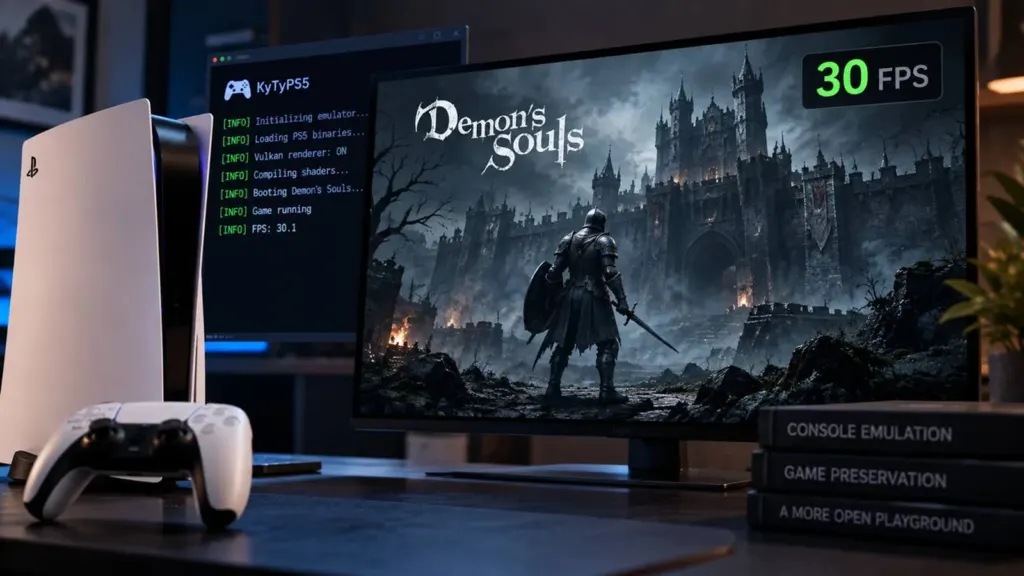
KyTyPS5, a community‑driven PlayStation 5 emulator, has posted footage of Bluepoint’s Demon’s Souls Remake running at a genuine 30 FPS in a static area of the game. The clip, released by YouTuber PSXTech, shows the title breaking past the 10‑18 FPS range it hovered at just two days earlier, and far beyond the 1‑2 FPS performance recorded a day before that. While the frame rate collapses to roughly 18 FPS when the camera moves and pacing remains uneven, the jump represents an 800 % improvement in less than a week.
The emulator’s progress timeline is striking. KyTyPS5 managed to boot past the character‑creation screen only a little over a week ago; prior expectations from the project’s own roadmap placed stable 30 FPS performance sometime in 2027. The rapid acceleration has sparked speculation across forums that AI‑assisted code generation may be accelerating reverse‑engineering tasks, though no developer has confirmed such a workflow. PSXTech did not disclose the PC hardware used for the capture, leaving the exact performance envelope unknown, but the visible improvement suggests that the bottlenecks in CPU emulation and GPU translation are being addressed at an unprecedented pace.
Demonstrating that Demon’s Souls is not the only title benefitting, the same emulator recently rendered the PlayStation 5 version of Grand Theft Auto V at up to 60 FPS and got Astro Bot into playable mode at roughly 11 FPS. These results remain far from a polished experience, yet they collectively illustrate a broader trend: PS5‑era titles are becoming technically tractable on consumer‑grade PCs, a reality that could reshape how preservationists, modders, and even casual gamers approach next‑generation console libraries.
Accelerating Emulator Performance
The underlying drivers of this acceleration are largely technical. Modern emulators rely on dynamic recompilation (dynarec) to translate console instructions into host‑machine code on the fly. Improvements in dynarec efficiency, combined with more aggressive caching strategies, have historically yielded incremental gains. However, the magnitude of the recent jump suggests a qualitative shift—potentially the integration of machine‑learning‑guided optimization passes that identify hot paths and rewrite them for the host architecture without human intervention. While the KyTyPS5 team has not released a changelog confirming AI involvement, the community’s observation of “AI‑assisted code” aligns with broader trends in software development where large language models assist in code synthesis and refactoring.
Hardware requirements remain a blind spot. The absence of disclosed specifications means readers cannot directly map the performance to a class of PCs. In prior emulator milestones, a high‑end desktop with a recent generation GPU and a multi‑core CPU was typically required to sustain double‑digit frame rates. If KyTyPS5 follows that pattern, the 30 FPS achievement may still be out of reach for mainstream users, preserving a performance gap that Sony can exploit. Nonetheless, the fact that a functional boot and now partial gameplay are possible on an emulator at all marks a departure from the “unplayable” label that dominated early 2026 reports.
Strategic Pressure on Sony
These technical strides intersect with a broader narrative in which Sony faces mounting public scrutiny. Recent coverage from Polygon frames PlayStation as the “villain” of the 2026 gaming season, a perception amplified by the franchise‑wide slump that left Marvel’s Wolverine unlikely to secure a Game of the Year nod—the first such omission for a PlayStation‑exclusive since 2014. The same season saw Sony preparing to distribute payments from a $7.85 million class‑action settlement, a process that many observers note will leave individual claimants with modest returns. Both stories underscore a growing sentiment that Sony’s market dominance is being challenged on multiple fronts.
Emulation advances add a technical dimension to that challenge. By enabling PC users to run PS5 titles without official hardware, emulators erode the exclusivity that underpins Sony’s ecosystem revenue. Preservation advocates argue that the ability to archive and study next‑gen games is essential for cultural heritage, while publishers worry about piracy and lost sales. The legal landscape remains unsettled; while the DMCA provides some protection for reverse‑engineering for interoperability, the line between preservation and infringement is still being drawn in courts.
From a competitive standpoint, the emulator’s progress could influence developer decisions. Studios that have traditionally leaned on Sony’s first‑party support might reconsider platform exclusivity if the technical barrier to cross‑platform availability diminishes. Conversely, Sony could double down on services that are harder to emulate, such as its proprietary network features, cloud saves, and subscription‑based titles, reinforcing a value proposition that transcends raw performance.
Critics caution that the current state of KyKyPS5 is still far from a consumer‑ready product. Frame‑rate drops when the camera moves, and noticeable pacing issues persist, indicating that the emulator’s graphics pipeline and synchronization mechanisms are not yet mature. Moreover, without transparent hardware benchmarks, the community cannot assess whether the performance gains are scalable across a range of PCs or confined to a narrow high‑end segment.
Nevertheless, the speed of improvement suggests that the emulator’s developers have identified and begun to close the most intractable bottlenecks. If the trend continues, the next logical milestone would be a stable 30 FPS experience across varied scenes, coupled with consistent frame pacing. Achieving that would place Demon’s Souls Remake within the realm of “playable” rather than “demo‑only,” a shift that could accelerate discussions about digital ownership, resale rights, and the longevity of console‑exclusive libraries.
In the short term, the practical impact on gamers remains limited. The emulator still requires a degree of technical expertise to configure, and the performance variance means that only a subset of players will experience a smooth session. However, the visibility of the 30 FPS clip has already sparked a surge in community interest, leading to more contributors joining the project and a higher likelihood of rapid iteration.
Ultimately, the KyTyPS5 milestone illustrates a convergence of technical ingenuity and market pressure that could reshape the console‑gaming equilibrium. While Sony retains control over its hardware sales and subscription services, the erosion of the technical monopoly on PS5 titles introduces a new variable into the competitive equation. As the emulator community refines its code and as legal precedents evolve, the balance between preservation, piracy concerns, and platform exclusivity will become an increasingly pivotal factor in the gaming industry’s strategic calculus.
Disclosure: Tech Tabloid may earn an affiliate commission from qualifying purchases through Amazon links on this page at no additional cost to you.