INNO3D Unveils High‑Density GPU Server as Power‑Connector Woes Surface
INNO3D’s AGS-6220V2 server packs dual 5th‑Gen Xeon CPUs and up to eight RTX PRO 6000 Blackwell GPUs into a 6U chassis, promising dense AI compute. A Reddit‑sourced fix for overheating RTX 5090 power connectors underscores the practical reliability hurdles that such high‑performance designs must address.
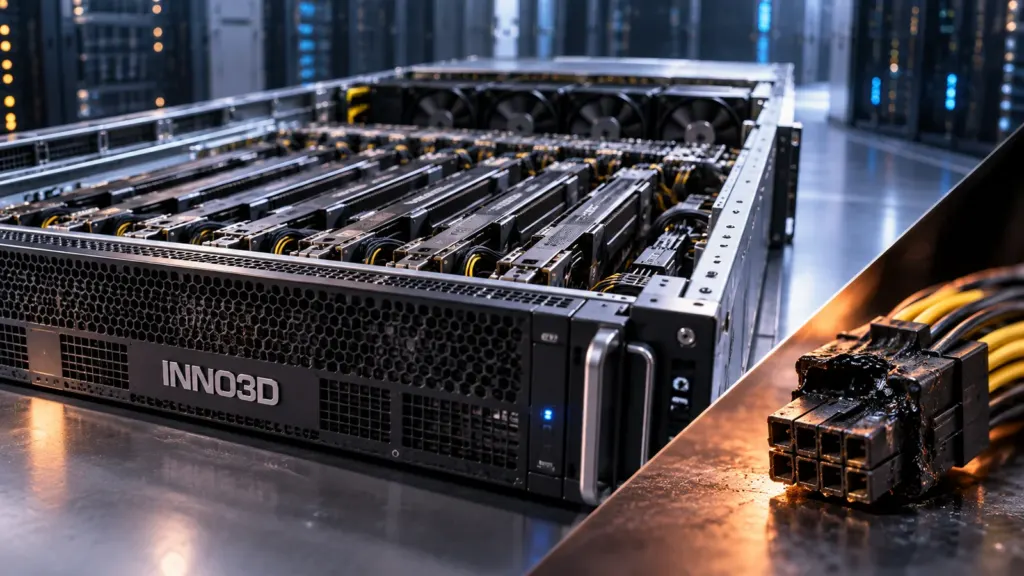
The surge in artificial‑intelligence workloads has forced data‑center operators to chase ever‑greater compute density, and the hardware ecosystem responds with ever‑more aggressive GPU‑centric designs. In that climate, INNO3D’s latest announcement – the AGS-6220V2 6U rack‑mount GPU server – stakes a claim on the high‑performance end of the market, promising to marry the raw horsepower of NVIDIA’s newest Blackwell GPUs with a compact, enterprise‑grade chassis.
According to the company’s press release, the AGS-6220V2 is built around dual 5th‑generation Intel Xeon Scalable processors, a platform that supports up to 32 DDR5 RDIMM modules. The server’s eight PCIe Gen 5 ×16 slots are populated with NVIDIA RTX PRO 6000 Blackwell Server Edition GPUs, a line positioned for AI training, inference, high‑performance computing (HPC), analytics, and visualization. The combination of a modern CPU foundation, high‑speed DDR5 memory, and the bandwidth‑rich Gen 5 interconnect creates a theoretical throughput that can sustain the most demanding data‑parallel tasks.
Beyond raw specifications, the AGS-6220V2’s 6U form factor signals a strategic shift toward density. By fitting eight high‑end GPUs into a chassis that occupies only six rack units, INNO3D aims to reduce the physical footprint and power envelope per unit of compute, a metric that data‑center managers track closely when planning expansion or retrofits. The announcement arrives as enterprises grapple with the cost of scaling AI clusters, making a compact, high‑density solution an attractive proposition if it can deliver on reliability and manageability.
Design choices that drive compute density
The decision to house eight RTX PRO 6000 GPUs in a 6U chassis reflects a clear engineering trade‑off: maximize GPU count while preserving enough space for cooling and power delivery subsystems. Each GPU draws a substantial amount of power through the 12VHPWR (12‑volt high‑power) connector, a standard introduced to accommodate the >300 W draw of modern GPUs. By arranging the GPUs in a staggered layout and leveraging the high‑speed lanes of PCIe Gen 5, INNO3D reduces bottlenecks that can arise from older interconnects, ensuring that each GPU can operate near its peak without being throttled by the bus.
Compared with traditional 4U GPU servers that often limit themselves to four or six GPUs, the AGS-6220V2’s eight‑GPU density offers a roughly 30‑40 % increase in compute per rack unit. This gain translates directly into lower capital expenditure for a given AI workload, assuming the supporting infrastructure – power distribution units (PDUs), cooling capacity, and rack space – can accommodate the higher heat and power density. The dual Xeon platform also provides ample PCIe lanes and memory bandwidth, reducing the need for additional host nodes in a clustered deployment.
From a performance standpoint, the Blackwell architecture introduces improvements in tensor core efficiency and ray‑tracing cores, which benefit both AI training and visualization pipelines. When paired with DDR5 memory, which offers higher bandwidth and lower latency than its DDR4 predecessor, the server can sustain larger model parameters and faster data movement. The combination positions the AGS-6220V2 as a compelling option for enterprises that need to run large language models, high‑resolution rendering, or complex scientific simulations within a constrained rack space.
Power‑delivery reliability and community workarounds
High‑density GPU servers, however, inherit a known pain point from the consumer market: the 12VHPWR connector’s susceptibility to overheating under sustained load. A Reddit user identified as u/DallasGrave posted a DIY solution for an RTX 5090 whose power connector was melting during intensive workloads. The fix involved attaching a custom‑fabricated distributor module to the back of the GPU, effectively spreading the current across a larger contact area and mitigating the hotspot.
This community‑driven modification underscores a broader reliability challenge that scales with server density. When eight GPUs share a limited power budget within a 6U chassis, any marginal inefficiency in connector design can compound, leading to thermal stress not only on the connectors themselves but also on surrounding components such as VRMs and motherboard traces. In enterprise environments, where uptime and hardware longevity are paramount, such issues translate into increased maintenance overhead and potential downtime.
From an engineering perspective, the root causes of connector overheating include insufficient contact plating, inadequate spring force, and the thermal coupling of the connector to adjacent heat‑generating components. INNO3D’s server design must therefore incorporate robust power‑delivery pathways, possibly through reinforced back‑plane designs, higher‑rated cabling, or active cooling solutions that target the connector region directly. The company’s announcement does not detail any specific mitigation beyond the standard 12VHPWR specification, leaving room for speculation about how the chassis addresses these known risks.
Enterprises evaluating the AGS-6220V2 can look to the Reddit fix as an informal benchmark of the stress points that may arise in real‑world deployments. While a custom distributor is not a production‑grade solution, it signals that the community is already identifying and addressing a failure mode that could affect data‑center reliability. Vendors that pre‑emptively reinforce connector durability or provide modular power‑distribution accessories may gain a competitive edge by reducing the need for after‑the‑fact retrofits.
Potential mitigation strategies include the use of higher‑current-rated cables, the integration of thermal pads or heat sinks directly onto the connector housing, and the implementation of firmware‑level power‑capping to smooth peak draw. Some server manufacturers have begun to adopt redundant power‑supply architectures that split the GPU load across multiple rails, thereby lowering the current per connector. If INNO3D incorporates similar safeguards, the AGS-6220V2 could alleviate the concerns raised by the community‑sourced RTX 5090 fix.
Market implications hinge on how quickly INNO3D can demonstrate that its power‑delivery design is resilient under sustained AI workloads. Early adopters—particularly those in research institutions and cloud providers—will likely conduct stress tests that monitor connector temperature, voltage droop, and overall system stability. Positive results could validate the server’s dense form factor as a viable path forward, while any repeat incidents of connector failure could push customers toward larger‑form‑factor solutions that spread power draw over more physical space.
In sum, the AGS-6220V2 showcases a clear technical ambition: deliver eight Blackwell GPUs within a 6U chassis without sacrificing the computational bandwidth required for modern AI tasks. At the same time, the community’s response to overheating issues on a consumer‑grade RTX 5090 highlights a practical reliability hurdle that must be addressed at the server level. The balance between raw performance and dependable power delivery will determine whether INNO3D’s high‑density offering gains traction in the enterprise AI market.