MagSafe vs USB‑C: Which Wins MacBook Charging?
Apple offers two charging options for modern MacBooks—MagSafe and USB‑C. This analysis weighs their safety, convenience, and ecosystem trade‑offs to guide users toward the most suitable choice.
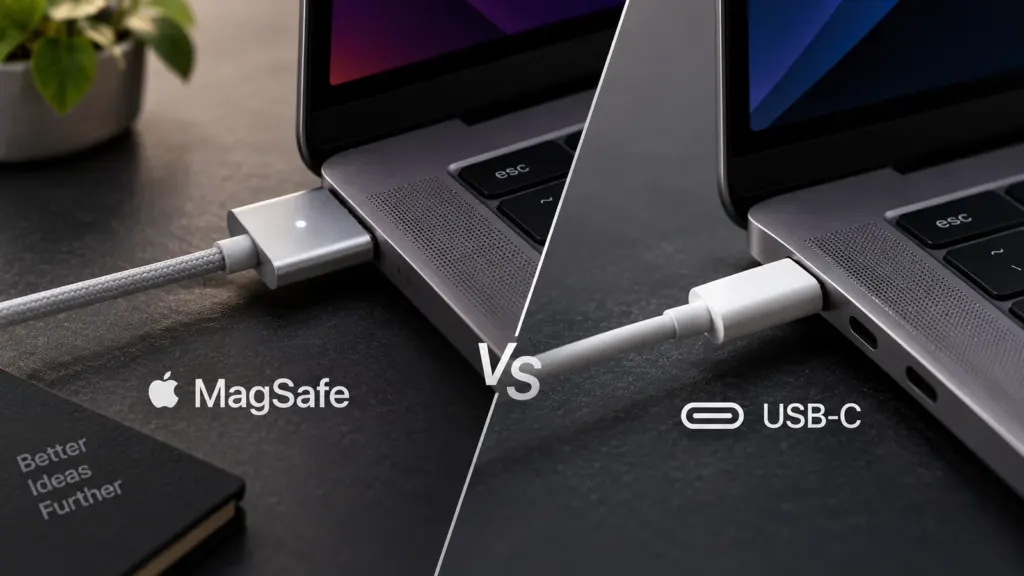
Modern MacBooks ship with both a magnetic MagSafe connector and a USB‑C port capable of delivering power. The coexistence of two standards raises a practical question for users: which method provides the better charging experience? The answer does not hinge on a single metric; instead it rests on a matrix of safety, ergonomics, accessory ecosystem, and long‑term flexibility.
MagSafe reappears after a decade‑long hiatus, marketed as a magnetic safety latch that detaches cleanly when the cable is tugged. Apple’s engineering blog emphasizes that the magnetic coupling reduces accidental drops and protects the laptop’s delicate hinge. By contrast, USB‑C is a universal standard adopted across laptops, smartphones, and peripherals. Its reversible plug and data‑transfer capabilities make it a versatile conduit for power, video, and networking, all through a single port.
From a user‑experience perspective, the two approaches diverge in everyday friction. MagSafe requires a dedicated charger, but the magnetic snap‑in feels deliberate and reassuring; the cable can be yanked without pulling the MacBook off a desk. USB‑C, however, lets users charge with any compliant power brick, a benefit for travelers and professionals who already carry USB‑C chargers for other devices. The trade‑off is that a hard pull on a USB‑C cable can stress the port, potentially leading to wear over time. Apple’s own support documentation notes that power adapter integrity matters for reliable operation, a point that applies equally to both connectors.
Safety and Convenience Trade‑offs
Safety is the most concrete advantage that MagSafe claims. The magnetic latch is engineered to release under a defined force, preventing the laptop from being yanked off a surface. This design also reduces stress on the internal charging circuitry because the connector never experiences a sudden torque spike. For users with pets, children, or cluttered workspaces, the magnetic release can be a decisive factor.
USB‑C’s convenience stems from its universality. A single cable can power a MacBook, an iPad, and a Windows laptop, eliminating the need to carry multiple chargers. The same port also supports fast‑charging protocols, though the exact wattage depends on the charger’s capabilities. Because the USB‑C specification is open, third‑party manufacturers can produce a wide range of power adapters, often at lower price points than Apple’s proprietary MagSafe bricks.
Both connectors support the same charging speed when paired with a charger that meets Apple’s power delivery requirements. In practice, the limiting factor is the charger, not the port. Consequently, a user who already owns a high‑wattage USB‑C power brick can achieve identical charge times on a MacBook without purchasing an additional MagSafe charger.
Ecosystem and Future Flexibility
The broader Apple ecosystem influences the decision. MagSafe integrates with a growing family of accessories—wireless charging pads, magnetic car mounts, and snap‑on docks—that leverage the same magnetic interface. These accessories promise a seamless experience for users who prioritize a tidy desk or a quick‑connect workflow.
Conversely, USB‑C aligns with the industry’s move toward a single, multi‑function port. As more peripherals adopt USB‑C Power Delivery, the MacBook’s USB‑C port becomes a gateway to a larger market of docks, external GPUs, and high‑resolution displays. For enterprises standardizing on USB‑C docking stations, retaining a USB‑C‑only workflow simplifies inventory and reduces cable sprawl.
From a longevity standpoint, the universal nature of USB‑C may future‑proof a MacBook against shifts in Apple’s accessory strategy. Should Apple introduce a new magnetic standard or retire MagSafe, users with a robust USB‑C charger ecosystem would face fewer disruptions. However, the magnetic ecosystem is expanding, and early adopters may benefit from first‑mover advantages such as exclusive accessory designs.
Ultimately, the choice hinges on user priorities. Professionals who value a secure, detachable connection and who plan to adopt Apple’s magnetic accessories will find MagSafe compelling. Users who travel frequently, already own USB‑C chargers, or need a single cable for multiple devices will likely favor USB‑C. The market signals—Apple’s continued investment in MagSafe accessories and the industry’s broad adoption of USB‑C—suggest that both options will coexist, giving consumers the flexibility to select the tool that best matches their workflow.