Scientists Rejuvenate Donated Livers, Extending Viability
New research shows that donated livers can be biologically rejuvenated, offering a path to longer preservation times. The analysis examines the science, potential impact, and challenges ahead.
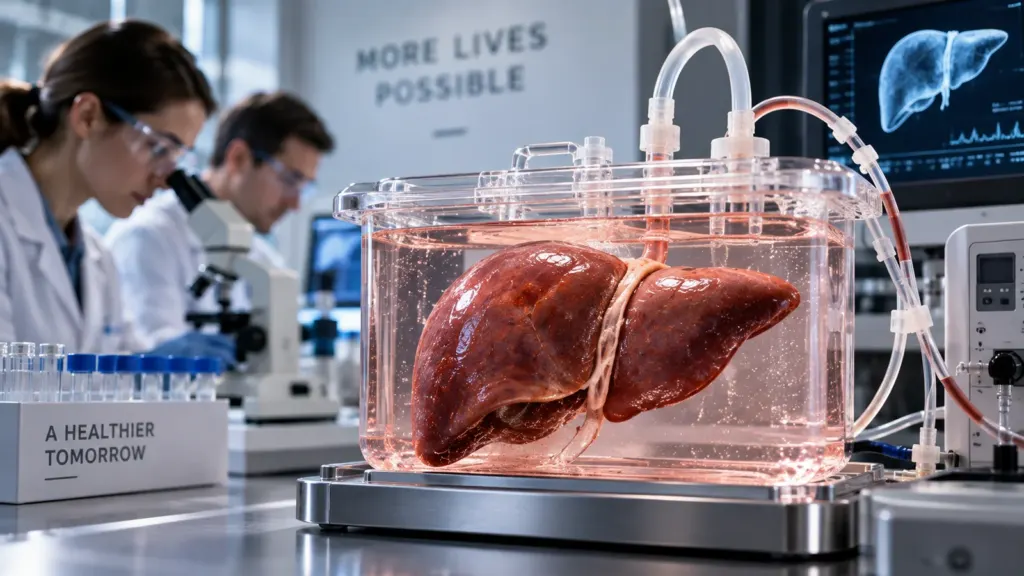
When a liver is removed from a donor, the clock starts ticking. Conventional practice flushes the organ with a cold preservative solution, bags it, and places it on ice, a process that buys only a few hours before cellular damage accelerates. Recent laboratory work demonstrates that the same organ can be treated ex vivo to reverse age‑related molecular markers, effectively making the tissue biologically younger and buying valuable time for transplantation.
The core of the approach lies in targeting cellular senescence, the state in which cells cease dividing and secrete inflammatory factors that impair tissue function. By delivering senolytic compounds, transiently re‑programming epigenetic marks, or applying controlled hypothermic perfusion with rejuvenating media, researchers have observed reductions in senescence‑associated β‑galactosidase activity and restoration of mitochondrial efficiency in liver slices. These biochemical shifts translate into measurable improvements in metabolic assays, suggesting that the organ’s functional reserve is bolstered beyond what cold storage alone can achieve.
Ex vivo perfusion platforms, already in clinical use for heart and lung preservation, provide the necessary conduit for delivering these interventions. The systems circulate oxygenated, nutrient‑rich fluid through the organ at sub‑physiological temperatures, maintaining viability while allowing precise dosing of therapeutic agents. In the reported experiments, perfusion runs lasted between four and eight hours, during which senolytic cocktails were introduced in a stepwise fashion. Post‑treatment analyses showed a 30‑40% drop in markers of oxidative stress compared with control livers that received standard cold storage.
Strategic Advantages for Transplant Networks
Extending the viable window for liver grafts reshapes several logistical bottlenecks. First, it eases the geographic constraints that currently force transplant centers to prioritize proximity, often discarding otherwise suitable organs that cannot be moved quickly enough. Second, it provides surgeons with a larger decision‑making horizon, reducing the pressure to accept marginal grafts under time duress. Third, the technology creates a new value proposition for organ procurement organizations, which can market rejuvenated grafts as higher‑quality assets, potentially influencing allocation algorithms that favor organs with better projected outcomes.
From a commercial perspective, companies that already supply perfusion devices stand to gain a differentiated service offering. The added step of biological rejuvenation could be packaged as a premium add‑on, generating incremental revenue streams while aligning with the broader goal of increasing transplant success rates. Moreover, the approach dovetails with ongoing research into gene‑editing tools that aim to correct donor‑specific metabolic defects, suggesting a future where a single perfusion session delivers both rejuvenation and precise genetic correction.
Patients also emerge as clear beneficiaries. Longer preservation times translate into reduced cold‑ischemia injury, a known predictor of post‑transplant complications such as primary non‑function and biliary strictures. By mitigating these risks, the technique could improve graft survival statistics, lower readmission rates, and ultimately reduce the overall cost burden on healthcare systems that manage chronic liver disease.
However, the pathway to routine clinical adoption is not without friction. Regulatory agencies require robust safety data, especially when introducing pharmacologic agents directly into a human organ destined for implantation. The perfusion environment adds a layer of complexity to pharmacokinetic modeling, as drug distribution differs markedly from systemic administration. Additionally, the cost of extended perfusion runs—both in equipment depreciation and consumables—must be justified against the incremental benefit in graft outcomes.
Critics point out that the current evidence base rests largely on pre‑clinical models and short‑term functional assays. Longitudinal studies tracking graft performance months or years after transplantation are still pending, leaving open the question of whether the observed molecular rejuvenation persists in vivo. Moreover, the heterogeneity of donor livers—varying in age, steatosis level, and comorbidities—means that a one‑size‑fits‑all protocol may not be feasible. Tailoring senolytic dosing to individual organ profiles could introduce operational complexity that outweighs the gains for certain marginal grafts.
Another counterpoint concerns ethical allocation. If rejuvenated livers are deemed superior, transplant committees may prioritize them over standard grafts, potentially disadvantaging patients on the waiting list who cannot access the technology due to geographic or institutional limitations. Transparent policy frameworks will be required to ensure equitable distribution while encouraging innovation.
Despite these challenges, the trajectory mirrors earlier breakthroughs in organ preservation, such as the adoption of normothermic perfusion for hearts and lungs. Those technologies faced similar skepticism before data demonstrated clear survival benefits, prompting guideline updates and insurance coverage expansions. The current rejuvenation research follows a comparable evidence curve: initial laboratory validation, followed by pilot clinical trials, and eventually, if outcomes remain favorable, integration into standard practice.
In the near term, several transplant centers have announced intent to enroll patients in controlled studies that will compare traditional cold storage against rejuvenated perfusion protocols. Endpoints include graft function at 24 hours, incidence of early allograft dysfunction, and long‑term survival at one year. The results of these trials will provide the concrete metrics regulators and payers demand before endorsing widespread use.
Ultimately, the ability to biologically reset a donated liver represents a convergence of cellular biology, bioengineering, and clinical transplantation. If the early signals hold, the technology could shift the calculus of organ scarcity, turning time from an adversary into a manageable variable. The next phase will hinge on rigorous clinical validation, cost‑effectiveness analysis, and policy alignment to ensure that the promise of younger grafts translates into real‑world patient benefit.