OpenAI taps Samsung, doubles down on AI chip sourcing
OpenAI expands its silicon strategy by adding Samsung as a second foundry for its upcoming AI ASICs. The move hints at massive volume needs and reshapes the competitive dynamics of AI hardware supply.
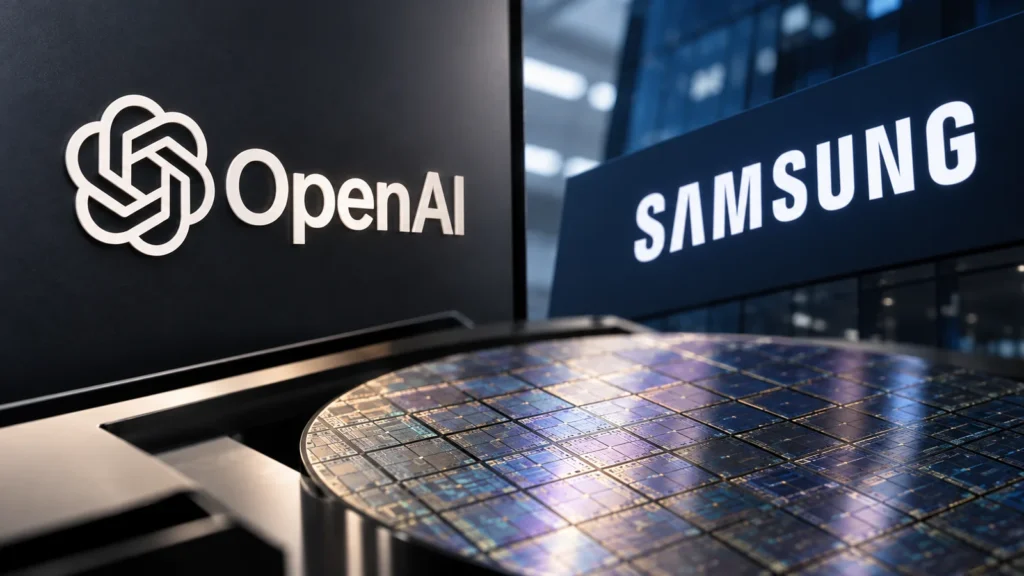
OpenAI announces that its next‑generation AI processors could be fabricated at Samsung, joining TSMC as a parallel source for the company’s custom ASICs. The dual‑foundry approach signals that OpenAI anticipates a scale of silicon demand that exceeds the capacity of a single supplier, and it forces analysts to reassess the competitive balance in the AI‑hardware ecosystem.
Historically, OpenAI has relied on TSMC’s leading‑edge process nodes to power its large language models. The new cooperation with Samsung suggests that the company is preparing for a volume surge that would strain even the most advanced fabs. By spreading production across two of the world’s most capable semiconductor manufacturers, OpenAI can mitigate supply‑chain bottlenecks, reduce lead‑time risk, and potentially negotiate more favorable pricing terms.
Strategic rationale behind double‑sourcing
The AI market in 2026 is defined by exponential growth in model parameters and inference workloads. Data‑center operators report that the compute‑to‑data ratio continues to climb, pushing the need for higher‑density, lower‑latency ASICs. OpenAI’s decision to involve Samsung aligns with three strategic imperatives:
- Capacity elasticity: Samsung’s 3‑nm and emerging 2‑nm process lines can absorb overflow orders when TSMC reaches its allocation limits, especially during peak demand cycles driven by new model releases.
- Technology diversification: While TSMC leads in power‑efficiency metrics, Samsung offers distinct design‑for‑manufacturing (DFM) optimizations that may translate into higher yields for specific circuit topologies used in transformer‑based inference engines.
- Geopolitical risk management: Maintaining production in both South Korea and Taiwan reduces exposure to regional disruptions, a consideration that has grown louder after recent supply‑chain shocks.
Implications for the AI‑hardware supply chain
OpenAI’s move reverberates beyond its own product roadmap. First, it raises the bar for other AI‑focused firms that have traditionally leaned on a single foundry. Companies such as Anthropic and Meta may feel pressure to adopt a similar multi‑foundry strategy to stay competitive in cost and capacity.
Second, the decision could accelerate Samsung’s push into high‑performance compute. Samsung has already announced a roadmap that includes advanced packaging techniques—such as interposer‑based 2.5‑D integration—that complement the dense compute blocks required for large language models. By securing a marquee customer, Samsung can justify further investment in these capabilities, potentially narrowing the performance gap with TSMC.
Third, the broader semiconductor market may see a shift in fab allocation dynamics. TSMC, which currently commands a dominant share of AI‑ASIC volume, could experience a modest rebalancing of its order book as OpenAI spreads its demand. This rebalancing may open capacity for other high‑margin customers, subtly reshaping the competitive landscape of AI hardware manufacturing.
Potential challenges and counter‑arguments
While the strategic benefits appear clear, the double‑sourcing model introduces technical and logistical complexities. Designing a chip that can be manufactured on two distinct process nodes requires careful coordination of design rules, verification flows, and timing closure. Any mismatch can lead to divergent performance characteristics, complicating software optimization and model deployment pipelines.
Moreover, the cost advantage of multi‑foundry production is not guaranteed. Samsung’s process pricing, especially for cutting‑edge nodes, may be higher than TSMC’s, eroding the anticipated savings. If Samsung’s yields lag behind TSMC’s, OpenAI could face higher per‑chip costs or delayed shipments, counteracting the intended risk mitigation.
Finally, the market could interpret the move as a signal that OpenAI’s current silicon roadmap is insufficient for projected workloads. Competitors might leverage that perception to argue that OpenAI is chasing scale at the expense of efficiency, potentially influencing customer procurement decisions.
Strategic outlook and measurable indicators
Analysts can monitor several concrete indicators to gauge the success of OpenAI’s dual‑foundry strategy:
- Quarterly fab allocation reports from TSMC and Samsung that disclose AI‑ASIC capacity commitments.
- Yield data released in OpenAI’s engineering blogs or conference presentations, especially any mention of cross‑foundry performance parity.
- Pricing trends for comparable AI ASICs in the market, which may reflect cost pressures or economies of scale.
- Supply‑chain risk metrics, such as lead‑time variance and geographic disruption indices, that track the resilience of OpenAI’s silicon supply.
Tracking these metrics will reveal whether the double‑sourcing approach translates into the anticipated volume elasticity and risk mitigation, or whether it introduces new layers of complexity that outweigh the benefits.
In sum, OpenAI’s decision to add Samsung as a second manufacturing partner marks a decisive shift in its hardware strategy. By seeking massive volume capacity across two leading fabs, the company positions itself to sustain the relentless growth of AI workloads while hedging against supply‑chain volatility. The move also nudges the broader AI‑hardware ecosystem toward greater diversification, setting a precedent that other AI developers are likely to follow as they confront similar scaling challenges.
Reporting transparency