Nvidia to Inject $3.5B in MediaTek, Boost AI
Nvidia will pour $3.5B into MediaTek, enabling the adoption of NVLink Fusion for its next generation of custom AI accelerators. The partnership will reshape local AI computing and automotive platforms, signaling a new era of chip collaboration.
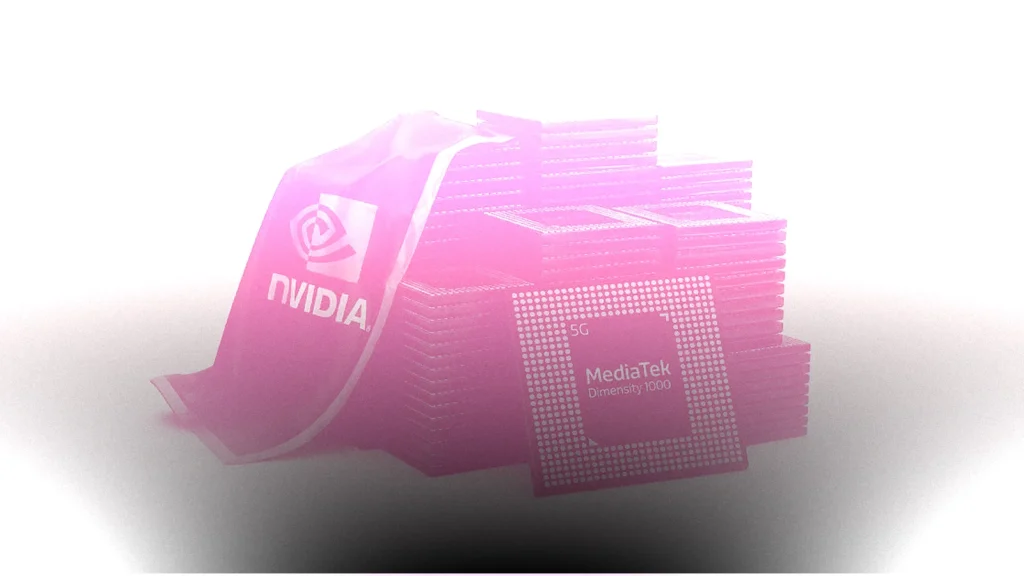
Power Play: Nvidia’s $3.5B Bet on MediaTek AI
Nvidia will invest $3.5B in MediaTek, a move that will cement a deep partnership centered on custom AI infrastructure. The capital infusion will unlock the adoption of Nvidia’s NVLink Fusion interconnect, a technology that will let MediaTek’s upcoming AI accelerators achieve unprecedented data throughput and energy efficiency.
NVLink Fusion: The Future of Chip-to-Chip Communication
NVLink Fusion will replace the traditional PCI‑e links that MediaTek’s current SoCs rely on. The new fabric will deliver up to 256GB/s of bidirectional bandwidth, a leap that will enable real‑time inference workloads to stay on the silicon rather than offloading to cloud servers. Nvidia will also provide a suite of software tooling that will ease the migration of existing AI models onto the new platform.
MediaTek’s Custom AI Accelerators
MediaTek will launch a family of AI accelerators that will sit alongside its Dimensity mobile processors. These accelerators will feature a mixed‑precision architecture that can execute 4,096 tensor operations per clock, a specification that will outpace the current MediaTek AI engine by a factor of three. Nvidia’s partnership will allow the accelerators to integrate NVLink Fusion natively, creating a seamless path from the chip to the data center.
Local AI Computing Gets a Boost
With NVLink Fusion, MediaTek will shift the paradigm of edge AI. The new accelerators will keep data on the device, reducing latency and preserving privacy for applications ranging from autonomous drones to smart retail kiosks. Developers will be able to train models on the cloud and deploy them directly onto MediaTek‑powered devices without the need for expensive GPU clusters.
Automotive Platforms: From Driver Assistance to Full Autonomy
MediaTek will apply the new architecture to its automotive SoCs, targeting Level‑4 autonomous systems. The increased bandwidth will support high‑definition sensor fusion, enabling vehicles to process LiDAR, radar, and camera streams in real time. Nvidia will provide a validated AI stack that will accelerate the certification process for automotive safety standards.
Competitive Landscape: Who Wins the Chip War?
While China’s semiconductor ambitions continue to face challenges, the Nvidia‑MediaTek collaboration will position both companies ahead of competitors that rely on legacy interconnects. The partnership will also set a new benchmark for power efficiency, with the accelerators projected to operate at 1.5W per TOPS, a figure that will outshine the current market leaders.
Implications for Developers and Consumers
Software ecosystems will evolve around the new hardware. Nvidia’s CUDA toolkit will receive extensions that target MediaTek’s mixed‑precision cores, allowing developers to write code once and run it on both Nvidia GPUs and MediaTek accelerators. Consumers will benefit from faster on‑device AI, such as real‑time language translation and augmented reality overlays, without relying on cloud connectivity.
Deep‑Dive Spec Snapshot
Developers will soon be able to access the new platform through Nvidia’s updated SDK, which will include pre‑built models for image recognition, natural language processing, and autonomous driving. The integration will also open doors for startups to build AI solutions on a cost‑effective, high‑performance foundation.