
BYOK Unleashes Scriptable Extensions, Turning Minimalist Keyboard into a Power Tool
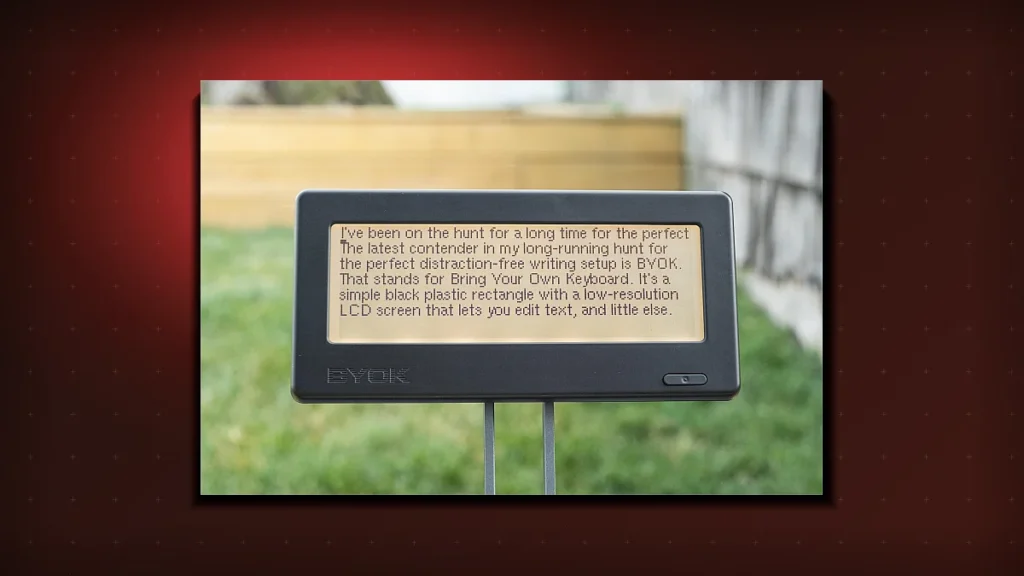
BYOK, the minimalist writing device, now supports user‑written scripts, opening a new frontier for distraction‑free creators. The move reshapes how writers and developers think about single‑purpose hardware.
When a device whose entire selling point is “no‑frills” decides to open its core to user‑authored scripts, the tech world takes notice. BYOK—short for “Bring Your Own Keyboard”—has announced a public extension framework that lets anyone write small programs to augment its pure‑text experience. The shift from a locked‑down e‑ink writer to a scriptable platform raises questions about architecture, security, and the very definition of a distraction‑free tool.
Why BYOK’s New Extension Engine Matters
For years, BYOK has catered to a niche audience: writers, journalists, and coders who value a tactile keyboard paired with an ultra‑low‑distraction display. The device’s appeal lies in its simplicity—no notifications, no apps, just a mechanical keyboard and a monochrome screen that mimics paper. By introducing an extension API, BYOK is effectively saying that simplicity can coexist with personalization.
The announcement, confirmed by both UA.NEWS and The Verge, frames the move as a response to community demand. Power users have long requested the ability to automate repetitive tasks—such as inserting boilerplate text, applying custom markdown shortcuts, or interfacing with cloud storage—without breaking the device’s core ethos.
Under the Hood: Scriptable Extensions
BYOK’s extension system is built around a sandboxed scripting environment. Developers can upload JavaScript (and, in future updates, Lua) files that run on a lightweight interpreter embedded in the device’s firmware. The interpreter enforces strict memory limits and isolates file I/O to prevent rogue scripts from corrupting the internal storage.
- API Surface: The provided API exposes only a handful of functions—
insertText(),readClipboard(), andtriggerSync()—ensuring that extensions cannot launch arbitrary network connections. - Security Model: Each script is signed with a developer key. The device verifies signatures at boot, rejecting unsigned code. This mirrors the approach taken by modern microcontroller platforms that prioritize deterministic behavior.
- Distribution: BYOK will host a curated marketplace on its companion web portal, allowing users to browse, rate, and install extensions directly over Wi‑Fi. Open‑source scripts can also be sideloaded via USB.
Who Gains? Writers, Developers, and the Minimalist Community
The immediate beneficiaries are power writers who spend hours drafting documents on BYOK. A script that auto‑formats headings or pulls citations from a local bibliography can shave minutes off each session, translating into measurable productivity gains over a typical workday.
Developers, too, stand to profit. The device’s low‑power e‑ink display and mechanical keyboard make it an attractive platform for building niche tools—think a markdown previewer that renders directly on the screen, or a Pomodoro timer that vibrates the keyboard chassis.
Critics worry that adding extensibility could erode the device’s original promise of distraction‑free writing. BYOK’s team counters that the sandbox model preserves the core experience; extensions run only when explicitly invoked, and the UI remains unchanged unless a script calls for a temporary overlay.
Pricing and Availability
As of the August 2026 announcement, BYOK retains its base price of $199 for the standard model, with a $49 “Pro Extension Kit” that includes a USB‑C hub and a 64 GB micro‑SD card for script storage. The extension marketplace launches in Q4 2026, with a handful of free community scripts and a premium “Citation Manager” priced at $9.99.
Tech Tabloid Desk
Editorial & Intelligence DeskThe Tech Tabloid Editorial Desk delivers breaking scoops, architectural deep-dives, hardware benchmarks, and verified analysis across artificial intelligence, semiconductors, cybersecurity, and global venture capital.