Huang Calls Trump onstage, Declares Robots Won’t Rule
Nvidia CEO Jensen Huang brings former President Trump onstage at the All‑In Summit to declare that robots will not take over the world. The call underscores the growing intersection of AI innovation and political discourse.
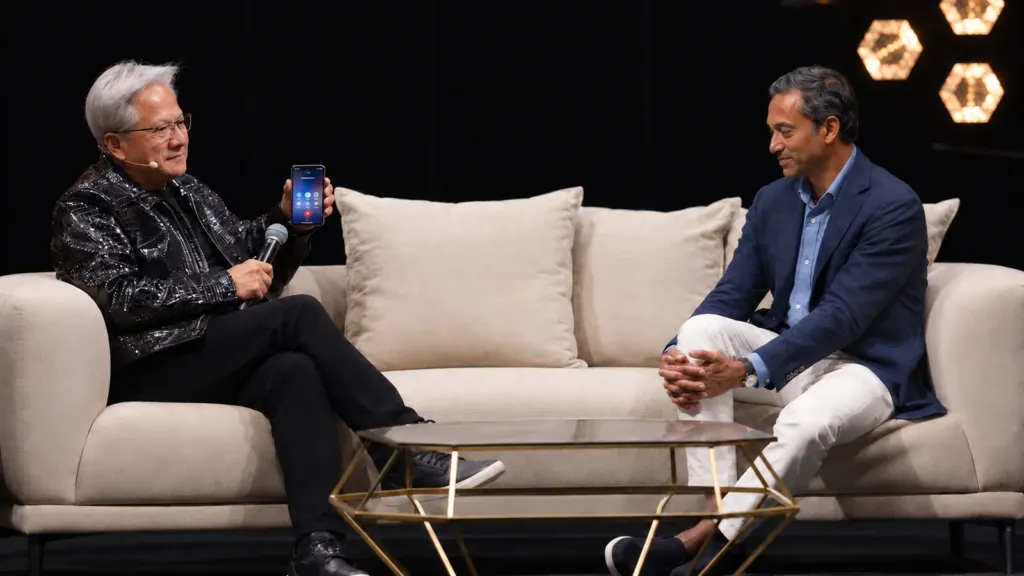
On the stage of the All‑In Summit, Nvidia CEO Jensen Huang surprised a packed audience by putting former President Donald Trump on speakerphone. The call, which began with Trump’s remarks on the future of artificial intelligence, ended with Huang affirming that robots will not take over the world. The moment, captured by live feeds, became a focal point for discussions on AI governance and the role of tech leaders in public policy.
Huang’s decision to bring Trump into the conversation was not the first time the Nvidia executive has engaged the former president on work matters. Earlier in the year, Huang had answered a call from Trump during a virtual meeting about data‑center policy, a conversation that was later described by the president as a “hoax.” The All‑In Summit call, however, was the first public instance in which the two leaders spoke directly to a live audience. The exchange highlighted the growing intersection of AI development and political discourse.
Political Echoes in AI Strategy
The call coincided with a broader debate over the pace of AI advancement. Anthropic CEO Dario Amodei recently urged the industry to slow the rate at which models are improved, citing safety concerns. His comments triggered a sell‑off in AI‑related stocks, while cybersecurity shares rallied as investors sought defensive positions. The juxtaposition of these market movements with the Trump‑Huang dialogue underscored the volatility surrounding AI policy.
Trump’s remarks on the summit were consistent with his social‑media narrative that frames AI regulation as a threat to innovation. In a post on his platform, the former president dismissed opposition to data‑center expansion as a “hoax,” a stance that aligns with Nvidia’s own lobbying efforts to ease regulatory constraints on chip manufacturing. The call therefore reinforced Nvidia’s public positioning as a pro‑innovation advocate while also acknowledging the political sensitivities that accompany large‑scale AI deployment.
From a strategic perspective, the call serves multiple purposes. First, it signals to investors and regulators that Nvidia remains engaged with political stakeholders, a factor that can influence policy outcomes. Second, it positions the company as a defender of free‑market principles in the face of growing calls for AI oversight. Finally, the public reassurance that “robots won’t take over the world” addresses consumer anxieties that have been amplified by sensationalist media coverage.
While the call’s immediate impact on Nvidia’s market valuation was muted, the broader narrative has implications for the company’s competitive advantage. Nvidia’s GPUs are the backbone of most large‑scale AI training pipelines, and any regulatory shift that hampers data‑center expansion could constrain the company’s growth trajectory. By aligning with a political figure who champions deregulation, Nvidia may be seeking to pre‑empt potential policy changes that could restrict its operations.
Critics argue that the call could be perceived as a political gamble, especially given the polarized reception of Trump’s public statements. However, the timing of the dialogue—amid a market downturn in AI stocks—suggests that Nvidia is attempting to mitigate reputational risk by presenting a calm, optimistic narrative. The company’s public statements emphasize continued investment in AI research while acknowledging the importance of safety and ethical considerations.
In the context of the broader AI ecosystem, the Trump‑Huang exchange illustrates the delicate balance between technological ambition and regulatory oversight. The call’s framing—robots will not take over the world—mirrors Nvidia’s broader messaging that AI is a tool, not a threat. This narrative aligns with the company’s recent initiatives to develop responsible AI frameworks, including the launch of the Nvidia AI Ethics Board in 2024.
Looking beyond the immediate spectacle, the call may influence how other tech leaders approach public policy. The visibility of a high‑profile CEO engaging directly with a former president could encourage similar outreach from competitors such as AMD, Intel, and Google. The resulting policy environment will likely be shaped by a mix of corporate lobbying, public sentiment, and legislative action, all of which will impact the pace and direction of AI development.
Ultimately, the event underscores the intertwined nature of technology, politics, and public perception. Nvidia’s willingness to place Trump on speakerphone demonstrates a strategic calculation: by engaging with political actors, the company seeks to safeguard its operational latitude while reassuring stakeholders that AI will remain under human control. The call’s resonance will be measured by subsequent policy decisions and market reactions, both of which will reflect the evolving relationship between AI innovation and regulatory frameworks.
As the AI industry continues to expand, the precedent set by the All‑In Summit call may become a reference point for future engagements between technology leaders and policymakers. The dialogue also highlights the need for clear communication strategies that balance optimism with realistic risk assessment. For Nvidia, maintaining credibility in both arenas will be essential to sustaining its leadership position in the AI hardware market.